No substantial new research directly addressing academic authorship or AI-assisted proofreading was identified since the pilot briefing. One newly published empirical study warrants attention for its relevance to cognitive agency.
Tier 1 · Core research
No substantive new research was identified for this tier.
Tier 2 · Wider research radar
Published 26 November 2026 · Peer-reviewed · Open access
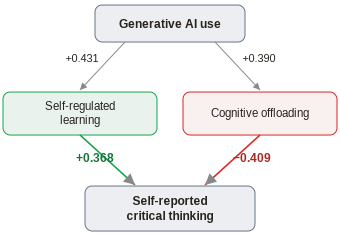
The study identifies two competing statistical pathways connecting generative AI use with students’ perceived critical thinking. The overall relationship was not statistically significant. Positive associations involving self-regulation coexisted with negative associations involving cognitive offloading.
Critical appraisal
Critical thinking was not independently assessed through performance tasks.
The offloading measure does not distinguish productive cognitive delegation from dependency.
Overlapping questionnaire constructs may inflate associations.
Neither temporal ordering nor causality can be established.
What the study does not establish
The study does not demonstrate that AI diminishes critical thinking, despite identifying a negative statistical pathway.
Two pathways in the statistical model
Diagram from the ChatGPT briefing, showing selected standardised path coefficients from Zhang (2026). These arrows show statistical associations, not causation. The published model also includes a link between self-regulation and offloading.
Methodology and critical appraisal
Feature
Assessment
Sample
378 undergraduates across 10 Chinese universities
Design
Cross-sectional questionnaire
Analysis
Structural equation modelling
Evidence
Self-reported practices and perceived ability
Causal inference
The design does not establish causation
Implications for PhD research
The distinction between productive cognitive delegation and intellectual substitution deserves further investigation. From an extended cognition perspective, transferring cognitive activity to an external resource need not represent a loss of agency. The pertinent question may instead be whether the individual retains meaningful control over the resulting cognitive process.
Four forms of engagement
Form of engagement
Illustrative writing activity
Cognitive delegation
Asking AI to correct punctuation
Cognitive scaffolding
Asking AI to identify weaknesses in an argument
Cognitive collaboration
Iteratively developing reasoning with AI
Cognitive substitution
Accepting an AI-generated argument without evaluating it
This is a proposed analytical distinction, not a validated taxonomy derived from Zhang’s findings.
Implications for the Academic Skills Centre
The study offers a rationale for exploring AI literacy teaching that emphasises metacognitive regulation rather than simply restricting AI use.
Before delegating a task to AI, identify which intellectual capability you are supposed to be developing and whether that delegation removes an opportunity to practise it.
This could be useful when discussing proofreading, formative feedback and disciplinary critical thinking with students. Its effectiveness would, however, need empirical evaluation.
Research watch
What the scan found
Priority area
New evidence since the pilot
Authorship and ownership
None identified
Cognitive agency
One relevant study
AI-assisted proofreading
None identified
Extended cognition
No direct empirical advance identified
Academic integrity
None identified
Reading priority: moderate. Zhang’s paper is worth retaining for its conceptual and methodological relevance, but it does not specifically investigate academic writing.
Search and access
This search covers an unusually short interval following the pilot. The publisher’s full-text article was checked, but its precise publication time on 26 November was unavailable. This is a targeted literature scan, not an exhaustive systematic search.