Four papers open the archive: student accounts of authorship, evidence from real revisions, AI-free writing assessments, and a wider review of academic integrity.
Executive summary
Recent research points towards a possible reconceptualisation of academic authorship: from independent textual production towards intellectual ownership through judgement, evaluation and decision-making. Of particular interest is the relationship between student agency during AI-assisted writing and subsequent independent writing capabilities.
Different dimensions of cognitive agency appear to have different relationships with learning. Agency may not be adequately understood as a single construct.
AI-assisted proofreading and revision can involve substantive intellectual changes. Active evaluation of suggested revisions is associated with better local outcomes.
Students describe ways to accommodate AI participation whilst retaining human intellectual responsibility.
This inaugural briefing covers September to November 2026, a broader window to establish a research baseline. Subsequent editions concentrate on new developments.
Tier 1 · Core research
Original research · Online first 2 November 2026 · Methods to note
Learner agency and independent writing development
How does student agency during AI-assisted academic writing relate to the development of independent writing skills?
Methodology
27 Japanese undergraduates undertaking a 14-week academic writing course.
Three AI-permitted essays and 81 reflective accounts.
Seven dimensions of learner agency examined.
AI-free writing assessments before and after the course’s AI-supported writing tasks.
Key findings
Different aspects of agency were associated with different writing outcomes. Learning orientation was linked to greater lexical diversity, whilst critical evaluation was linked to increased clause density. However, the combined measure of agency was not significantly associated with changes in independent writing.
Critical appraisal
The small sample, specialised language-learning context and reliance on reflective accounts limit generalisability. The associations do not establish causation. The linguistic outcomes are not measures of the quality of argumentation.
Implications for PhD research
Rather than measuring agency using a single aggregate score, consider separating metacognitive awareness, intellectual ownership, critical evaluation and decision-making autonomy. A student could exhibit considerable agency in one dimension whilst surrendering it in another.
Original research · Online first 13 October 2026
When proofreading becomes intellectual intervention
How does students’ evaluation of AI-generated revisions relate to the quality and intellectual integrity of their writing?
Methodology
The authors analysed 40 undergraduate English majors’ work: 160 drafts, 80 reflective accounts and 793 traceable revision episodes.
Key findings
Visible checking was associated with more local improvements in higher-risk revisions: 84.6% versus 39.6% among revisions whose consequences could be determined. No significant association between revision uptake patterns and whole-document improvement remained after correction for multiple comparisons.
Critical appraisal
This was observational rather than experimental. Agreement between whole-text assessors was moderate. Improvements to individual passages cannot automatically be equated with improvements in overall intellectual quality. Appraisal based on the abstract and available publisher extracts.
Implications for academic integrity
Categorising AI-assisted revision simply as proofreading is potentially misleading. Revisions may alter interpretation, evidential relationships and authorial stance.
Implications for the Academic Skills Centre
Teach students to evaluate AI-generated amendments according to their cognitive consequences rather than their superficial linguistic appearance. This is the most immediately applicable paper in this edition for academic skills teaching.
Local improvement after higher-risk suggestions
Visible checking84.6% (143 of 169 episodes)
84.6%
No visible checking39.6% (122 of 308 episodes)
39.6%
Recreated from the values shown in the ChatGPT briefing and verified against Huo et al. (2026), Table 8. Only substantive-risk revisions with determinate consequences are included. This comparison is observational and does not measure improvement across a whole draft.
Original research · 20 September 2026 · Essential reading
How do students negotiate authorship, ethical responsibility and learning when using generative AI?
Methodology
Qualitatively driven mixed-methods research involving 55 student reflections and 27 questionnaire responses from an undergraduate academic writing course in Cyprus.
Key findings
Participants framed ownership primarily through evaluation, verification and control over intellectual decisions rather than through exclusive responsibility for producing every word.
Critical appraisal
This was a small study in a single institution. The coursework reflections may reflect instructor expectations. Reported ethical behaviour was not independently verified.
Implications for PhD research
The study offers a basis for investigating perceived authorship as distinct from textual production. Does exercising final authority over AI-generated material constitute intellectual authorship, or can the perception of authority persist even when substantive cognitive agency has been delegated? That is a research question, not a conclusion established by the study.
Tier 2 · Wider research radar
Systematic review · Accepted article online 13 November 2026
The review of 55 studies identifies considerable variation in institutional responses to AI-assisted writing, alongside concerns about transparency, authorship, fairness and detection technology. About a quarter of included studies reported evidence of misuse in graded work. That is a proportion of studies, not an estimate of students who committed misconduct.
Why it matters
The review gives useful policy context for teaching and student guidance but does not establish how AI changes authorship or learning in an individual writing task.
Cross-study synthesis
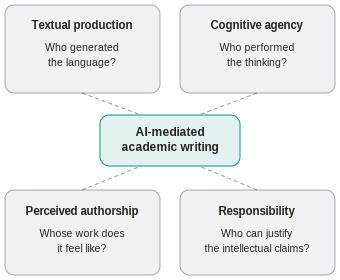
Four questions about AI-assisted writing
Diagram from the ChatGPT briefing. A conceptual synthesis of the pilot’s readings, not an empirically validated model.
These four constructs can diverge. A student might generate very little of the final language but exercise considerable intellectual agency. Conversely, a student might manually write every word of an argument whose reasoning was substantially generated by AI. This exposes a weakness in approaches to academic integrity that primarily concern themselves with the provenance of the finished text.
Implications for PhD research
Three propositions are worth investigating empirically.
From a proposition to a study design
Proposition
Potential investigation
Perceived authorship and cognitive agency may diverge
Compare ownership ratings with observed decisions during writing.
Linguistic support can change intellectual content
Track changes in claims, reasoning and stance after AI proofreading.
Agency may have multiple dimensions
Measure distinct forms of agency alongside any overall rating.
Another potential variable is the visibility of the tool: does conversational rather than embedded assistance affect students’ awareness of what AI contributed intellectually? None of the studies featured here directly resolves that question.
Implications for work on AI and human capabilities
Rather than asking only which capabilities students need to retain in an AI-rich environment, research could ask a more specific question:
Which human cognitive capabilities must remain active when intellectual work is distributed across human and artificial systems?
Cognitive offloading does not necessarily constitute cognitive extension, and neither necessarily entails diminished human agency. Those relationships require investigation rather than assumption.
Reading priorities
Savvidou (2026): closest to the central questions about perceived authorship.
Huo et al. (2026): strongest immediate application to proofreading guidance and academic skills teaching.
Wang and Stockwell (2026): most useful for research design and operationalising agency.
Overall assessment
How to weigh the evidence
Criterion
Assessment
Relevance to authorship and academic skills
High
Strength of empirical evidence
Moderate
Evidence of causal effects
Limited
These studies ask more than whether students use AI. They investigate what happens to judgement, participation and writing when students do use it.
Search and access
This pilot is a targeted literature scan rather than a systematic search. Some publisher pages restricted direct full-text access, so parts of the appraisal rely on indexed abstracts and available extracts. The conceptual synthesis and proposed research directions are interpretations, not established findings.